









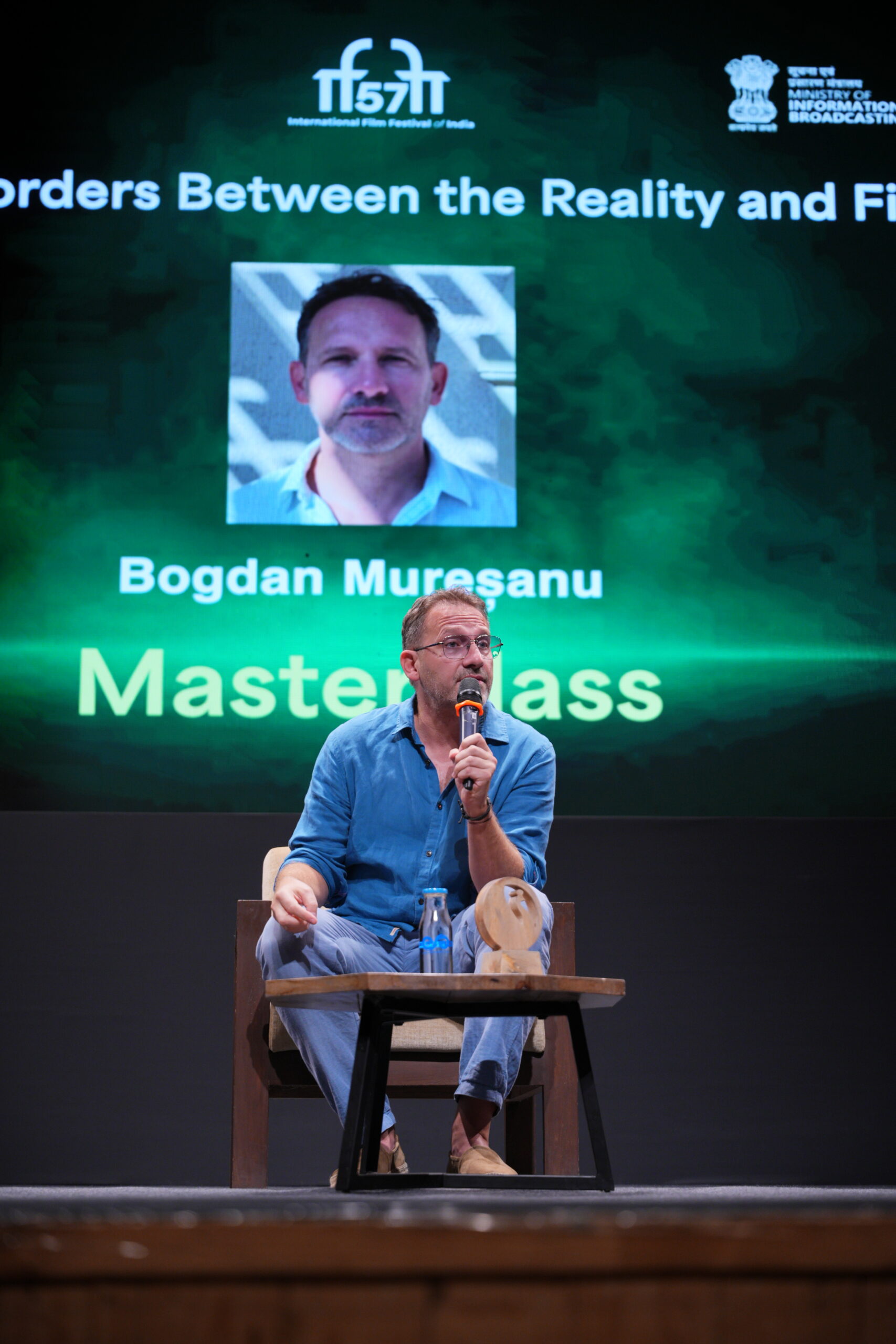
Romanian filmmaker Bogdan Mureșanu has emphasised that storytelling is an intrinsic part of human existence, asserting that every individual, and not just filmmakers, has stories to tell.
Speaking at a masterclass titled ‘The Thin Borders Between Reality and Fiction’ at the 57th International Film Festival of India (IFFI) in Goa today, Mureșanu explored the relationship between real-life experiences, memories and cinematic imagination.
Interacting with cinephiles, students and film professionals, the writer-director and producer explained how stories help people understand the world, explore alternative realities and connect with one another. He described filmmaking as a personal creative process that eventually becomes a collective experience when audiences interpret and engage with the filmmaker’s vision.
Emphasising the importance of a strong central idea, Mureșanu said that unlike novels, which can accommodate multiple narrative diversions, feature films must maintain a focused storyline with their context, premise and themes aligned to a clear vision.
He also highlighted the importance of subtlety and imagination in cinema, explaining how deliberately leaving certain moments unseen can encourage audiences to participate emotionally in the storytelling process.
Drawing from his films ‘The Christmas Gift’ and ‘The New Year That Never Came’, Mureșanu challenged the notion that archival footage presents history objectively, pointing out that every camera captures only a particular perspective. He explained how fiction and archival material can complement each other in interpreting historical realities, observing that fiction can serve as a simplified model for understanding reality.
Discussing the role of visual language, he explained his use of the 4:3 aspect ratio in films depicting Romania’s communist era to create a sense of intimacy and confinement while complementing archival footage. In contrast, his animated short ‘The Magician’ employed a widescreen format to give the harbour a more prominent narrative role.
Reflecting on contemporary cinema, Mureșanu stressed that cinematic power lies not merely in visual spectacle or fast-paced storytelling but also in the expressive potential of human faces, gazes and emotions.
The interactive session also examined the challenges of portraying historical personalities, mythology and real-life figures in biographical films. He suggested that focusing on a defining phase of a person’s life can often offer deeper insights than attempting to cover an entire biography.
Concluding the masterclass, Mureșanu encouraged aspiring storytellers to move beyond inherited perspectives, engage with the wider world and reconnect with their roots with courage and clarity.