










Social issues, family relationships, environmental conservation, education, personal aspirations and political struggles will take centre stage at the 57th International Film Festival of India (IFFI), with a diverse selection of Tamil and Telugu films showcasing the richness of regional cinema.
The selection, spanning feature films, non-feature productions and a special Golden Jubilee presentation, brings together stories rooted in different social and cultural settings while exploring themes that resonate beyond linguistic boundaries.
Tamil Films Explore Social Issues, Family and Environment
The Tamil film selection includes narratives addressing contemporary challenges as well as traditional values and indigenous knowledge.
‘Scroll’, directed by Kannan S, explores smartphone addiction through the story of Aravind, a young man who joins an app called Dopa Rush to overcome his dependence on mobile phones. What begins as a series of challenges and rewards soon turns disturbing as the app starts controlling the lives of its participants.
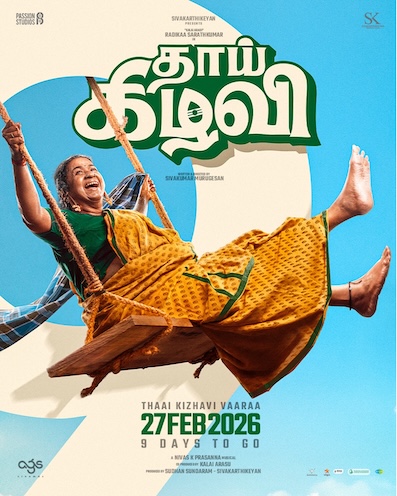
Family conflicts and buried secrets form the core of ‘Thaai Kizhavi (God Mother)’, directed by Sivakumar Murugesan. The film follows Pavunuthaayi, a strong-willed 70-year-old woman who has been estranged from her three sons for years. When she falls seriously ill, their return home revives old conflicts and brings a long-hidden family secret to light.
Education and social barriers are explored in ‘Arivu’, directed by Sathyashiva. Set in 1996, the film follows Kathir, a young teacher posted to a remote tribal village in the Western Ghats, where girls are denied education due to traditional beliefs. Determined to challenge the practice, he secretly teaches girls who have never attended school and helps them prepare for their examinations.
‘Attappadi’, directed by Vijeesh Mani, highlights the traditional medicinal knowledge and forest-based practices of indigenous communities in Kerala’s Western Ghats. The film follows Sultan Ahmed Al Mehmoudi, who travels from Arabia to learn about the region’s medicinal heritage, meeting traditional healers and elders and discovering their deep connection with nature.
Environmental conservation and collective action are at the heart of ‘Koodu (Nest)’, directed by Joyal Vijay. Set in Vachathi, Tamil Nadu, the film follows villagers who decide to remain without electricity for 35 days after discovering a sparrow’s nest containing eggs inside a village transformer. Led by village head Agathiyan and agriculture graduate Kathir, the community faces opposition and sabotage while making sacrifices to protect the birds.
Telugu Films Address Nature, Relationships and Politics
The Telugu selection brings together stories exploring environmental protection, love, individual aspirations, human values and political power.
‘Sing Geetham (Sing a Song)’, directed by Singeetham Srinivasa Rao, revolves around Pratap Mannem, who returns to his mining village of Kuberpuram to claim his inheritance. His confrontation with a former business partner, whose expansion plans threaten the village’s last tree, leads him to uncover truths about his family’s past. The story explores greed, unity, sacrifice and the importance of protecting nature.
Love, tragedy and grief form the narrative of ‘Chennai Love Story’, directed by Ravi Varma Namburi. The film follows Nivi, who finds happiness and companionship with Steven, an orphan whose kindness helps her overcome a painful past. Their decision to marry is shattered when Steven dies in an accident on their wedding day, leaving Nivi struggling to cope with his sudden loss.
The pursuit of personal dreams is explored in ‘Why, Vani?’, directed by Dhanush Dandu. The film centres on Vani, a young Hyderabad-based editor who gets an opportunity to work on a documentary in Mumbai and pursue her filmmaking ambitions. Her decision creates tensions in her personal and professional relationships, forcing her to confront family expectations, compromises and guilt before finding the confidence to follow her dreams.
‘Win’, directed by Praveen, uses chess to explore ego, discipline and the meaning of success. The story follows Napoleon, an 18-year-old chess player who loses a major tournament to Gayatri, a calm 10-year-old girl. Unable to accept defeat, he challenges her again. Through their conversations and the teachings of the Bhagavad Gita, Gayatri helps him understand that playing well and performing one’s duty matter more than winning.
Politics, friendship and ideological conflicts provide the backdrop for ‘Mayasabha’, directed by Deva Katta. Set in Andhra Pradesh from the mid-1970s, the series follows two young men from contrasting backgrounds — idealistic student leader Kakarla Krishnama Naidu (KKN) and M.S. Rami Reddy (MSR), who belongs to a powerful family. As they enter politics together, caste divisions, corruption, money and power struggles begin testing their ideals and friendship.
‘Bhakta Kannappa’ Returns in Golden Jubilee Section
A special attraction in the Telugu selection will be the screening of ‘Bhakta Kannappa’, directed by Bapu, as part of IFFI 2026’s Golden Jubilee celebrations. The restored film marks 50 years since its original release on May 26, 1976.
The film retells the legend of Kannappa Nayanar, a celebrated devotee of Lord Shiva. It follows Thinnadu, an atheist hunter raised by a tribal chief, whose encounter with Lord Shiva transforms his understanding of faith and devotion. In the film’s defining climax, he offers his own eyes to stop the Shiva Lingam from bleeding, demonstrating devotion beyond ritual and convention.
Originally filmed in Kannada, the production is remembered for its grand outdoor settings and scale. It also won the National Film Award for Best Audiography.
The Tamil and Telugu selections reflect the overarching theme of the 57th IFFI, ‘Stories Without Borders’, demonstrating how regional cinema can address universal human experiences. From education and environmental protection to family bonds, political rivalries, personal struggles and spiritual devotion, the films highlight the diversity of India’s storytelling traditions while bringing audiences closer to different cultures and perspectives.
The 57th International Film Festival of India will be held in Panaji from November 20 to 28, organised by the Ministry of Information and Broadcasting and the National Film Development Corporation (NFDC), in association with the Entertainment Society of Goa (ESG).