









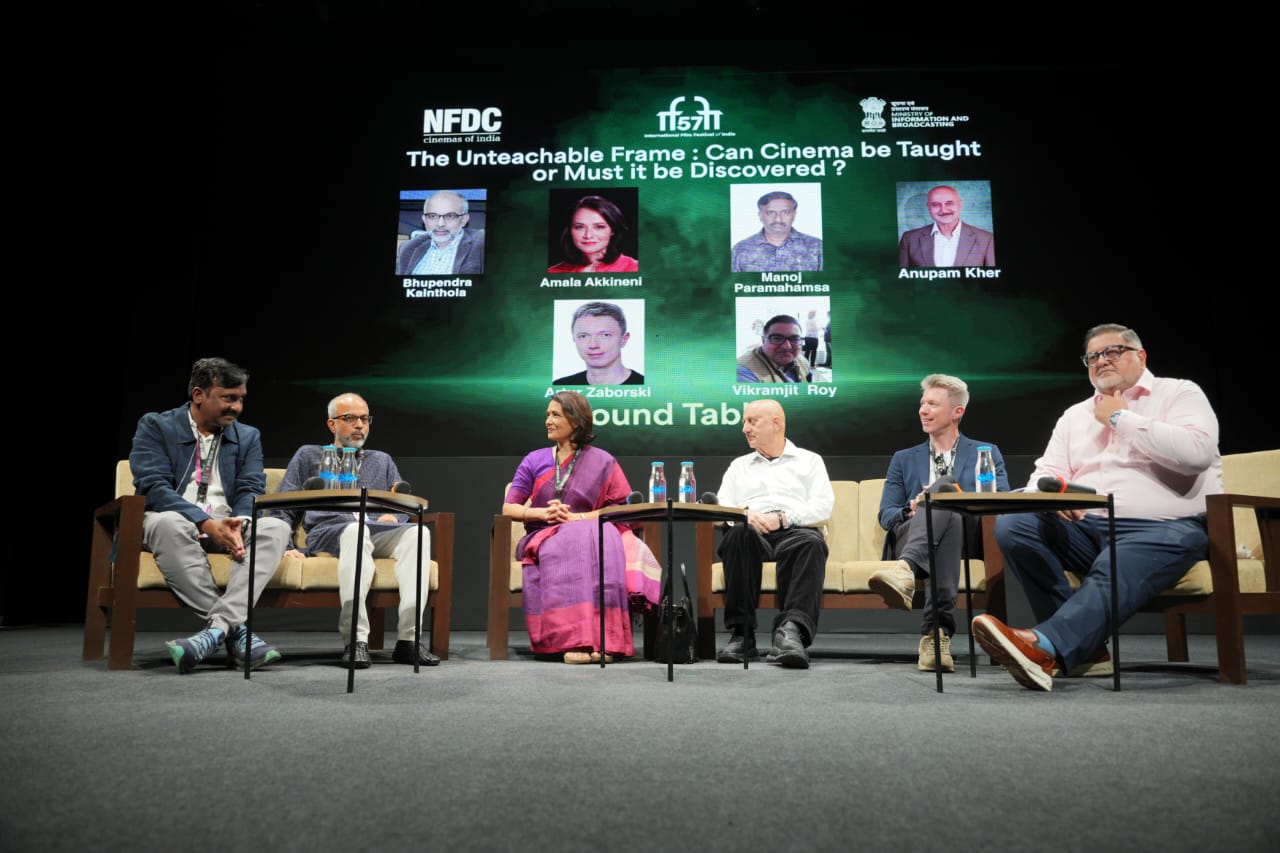
The role of formal film education in nurturing creative talent and preparing aspiring filmmakers for the challenges of the industry came under discussion at the 57th International Film Festival of India (IFFI) during a panel session titled ‘The Unteachable Frame: Can Cinema Be Taught or Must It Be Discovered?’
The discussion brought together prominent personalities from the Indian and international film industries, who shared their perspectives on the importance of film schools, practical training, creative experimentation and emerging technologies in filmmaking.
The panel featured actor and director of Annapurna College of Film and Media Amala Akkineni; actor and founder of Actor Prepares Anupam Kher; Artur Daborski of Warsaw Film School; former Film and Television Institute of India (FTII) director Bhupendra Kainthola; and cinematographer and Cinema Factory Academy founder Manoj Paramahamsa. The session was moderated by Vikramjit Roy, who has held leadership positions at Sony Pictures India and NFDC.
Amala Akkineni highlighted the collaborative nature of filmmaking, stating that film schools provide students with opportunities to understand different filmmaking disciplines and work as teams. She also stressed the need to challenge gender stereotypes and encourage more women to pursue professional filmmaking education.
Anupam Kher emphasised the importance of formal training in developing an actor’s abilities, recalling how his education at the National School of Drama (NSD) helped him prepare for challenging roles. Referring to his portrayal of a 65-year-old man in his debut film Saaransh at the age of 28, he said, “I would not have been sitting here had I not gone to National School of Drama.”
He identified observation, imagination and emotional memory as essential qualities for actors, explaining that life experiences provide valuable material for portraying characters convincingly. Highlighting the importance of understanding the nine emotions or Navarasas, he advised aspiring actors to learn from everyday experiences.
“Every experience teaches you something. What you learn as a human being will help you in your acting,” Kher said. He also cautioned young artists against complacency, urging them to continuously improve their craft.
Artur Daborski stressed that filmmaking requires sustained practice, international exposure and familiarity with different cinematic traditions. He highlighted the role of film festivals in broadening the perspectives of young filmmakers and introducing them to diverse approaches to storytelling.
Sharing the Warsaw Film School’s approach, he said students are encouraged to make films in a supportive environment where they can experiment and learn from mistakes without the financial and operational pressures associated with professional film sets.
He also underlined the importance of teaching students the business aspects of filmmaking, including pitching projects, approaching producers, securing funding and understanding the professional ecosystem. Encouraging young filmmakers to explore meaningful subjects, he said films should engage with issues that challenge or concern them.
Former FTII director Bhupendra Kainthola summed up the relationship between creativity and formal education by observing, “Art can be discovered, but craft has to be taught.”
He said creativity needs to be supported by discipline, structured learning and professional processes. He also emphasised the responsibility of publicly funded institutions such as FTII to provide aspiring filmmakers with an environment in which their creative ambitions can flourish.
Cinematographer Manoj Paramahamsa pointed out that professional film sets operate under considerable practical and financial constraints, leaving little room for beginners to experiment. Film schools, therefore, play an important role in teaching technical fundamentals while developing teamwork, coordination and human resource management skills.
AI and human creativity
The panel also examined the growing influence of Artificial Intelligence (AI) on filmmaking and film education.
Paramahamsa noted that AI is increasingly being used to automate repetitive tasks, generate preliminary storyboards and improve production workflows. Technological developments are also enabling filmmakers to modify backgrounds and create sophisticated visual environments after filming.
While acknowledging the growing role of technology, Kher maintained that human emotions remain irreplaceable in creative expression. Referring to AI-generated virtual avatars, he observed that technology may create images and performances, but cannot reproduce the heart and soul that human beings bring to acting.
The discussion highlighted that while creativity and artistic instincts may be discovered, professional filmmaking requires structured training, technical knowledge, practical exposure and continuous experimentation. It also stressed the need for film education to evolve alongside technological changes while retaining human storytelling at its core.
The 57th IFFI is being held in Goa from November 20 to 28, 2026, bringing together filmmakers, industry professionals and cinema enthusiasts from India and abroad through film screenings, masterclasses and interactive discussions.